
Makkah Deputy Governor Inspects Facilities Readiness at Holy Sites Ahead of Hajj
Deputy Governor of Makkah Region and Deputy Chairman of the Permanent Committee for Hajj and Umrah Prince Saud bin Mishaal bin Abdulaziz conducted a field inspection of facilities in the holy sites, reviewing their readiness for Hajj.
Vice Minister of Hajj and Umrah Abdulfattah Mashat, Mayor of Makkah Region Musad Al-Dawood and Director of Public Security Lt. Gen. Mohammed Al-Bassami accompanied Prince Saud bin Mishaal during this tour, alongside officials from relevant authorities.
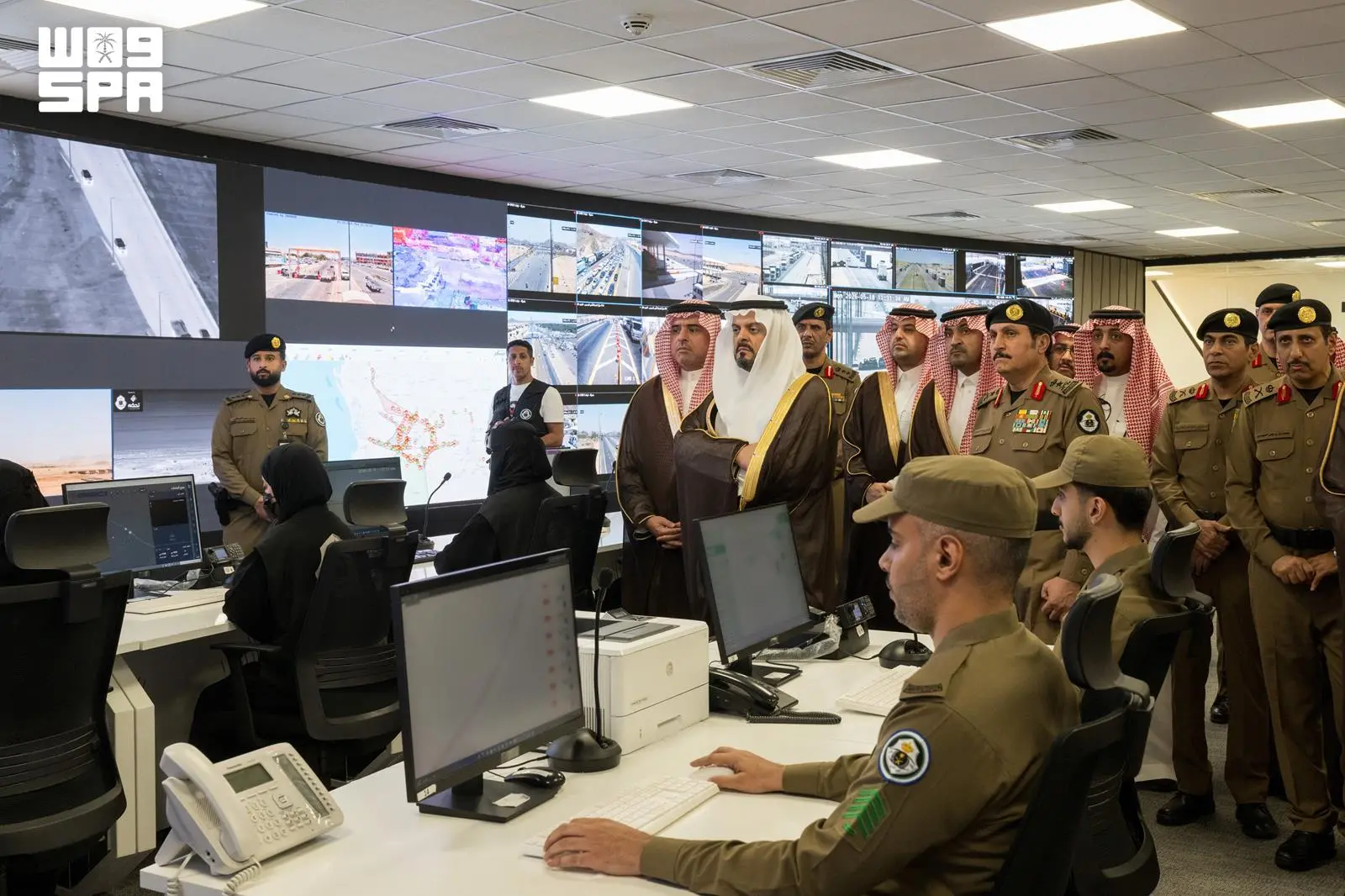
He began his tour with a visit to Al-Shumaisi checkpoint on the Makkah-Jeddah highway.
Prince Saud bin Mishaal was briefed on the facility, which includes 16 lanes equipped with advanced smart technologies, administrative offices for traffic security, a building housing 10 government entities, and staff accommodation.
The point helps streamline vehicle movement and facilitate the entry of pilgrims, Umrah performers, and visitors to Makkah. It also serves as a modern architectural gateway to the holy city, equipped with advanced inspection and screening technologies to facilitate entry.
The deputy governor also reviewed the operational plan aimed at facilitating services for pilgrims, as well as the work of the reporting and monitoring unit and its mechanism for handling and processing reports.
Prince Saud bin Mishaal then proceeded to the holy sites, where he visited Mina Emergency Hospital 2, which spans more than 5,300 square meters and has a capacity of 200 beds distributed across emergency, inpatient, heatstroke, and heat exhaustion treatment units. The hospital also has advanced capabilities in radiology and laboratory services, outpatient clinics, minor surgery units, isolation and resuscitation units, and staff support areas.
The operation of Mina Emergency Hospital 2 is part of the Ministry of Health's efforts to expand medical coverage during Hajj and to ensure a faster response to emergency cases, while providing a fully equipped treatment environment within the holy sites. The hospital is among the fastest in the world to be constructed and brought into operation, and it functions around the clock with high efficiency.
Prince Saud bin Mishaal was also briefed on field hospitals, which now exceed 15 facilities established in cooperation with various health and security entities, as well as urgent care services designed to ease pressure on emergency departments and speed up treatment of mild and moderate cases.
The healthcare system has increased its operational capacity to more than 20,000 beds, supported by over 52,000 medical workers serving pilgrims. It also operates 25 urgent care centers across the holy sites, more than triple last year’s number, along with more than 900 ambulances, 11 medical evacuation aircraft, and 71 field emergency points.

 Facebook
 Twitter
 Whatsapp